Calm Solitaire: Classic Card
- 4.1
- Rating
- 500.00K
- Installs
- Free
- Price
 Analysis by App-foxy
I spent time with Calm Solitaire: Classic Card as the kind of game people open when they want something familiar rather than something demanding. Its appeal is easy to understand: this is a free classic card game from Puzzle Brain Games, built around the quiet rhythm of Solitaire instead of competition, storytelling, or complicated progression. My overall view is positive, but with an important qualification: it works best as a simple, low-pressure way to fill a few minutes, not as a deep card-playing experience for someone looking for a large collection of modes or a strong sense of long-term advancement.
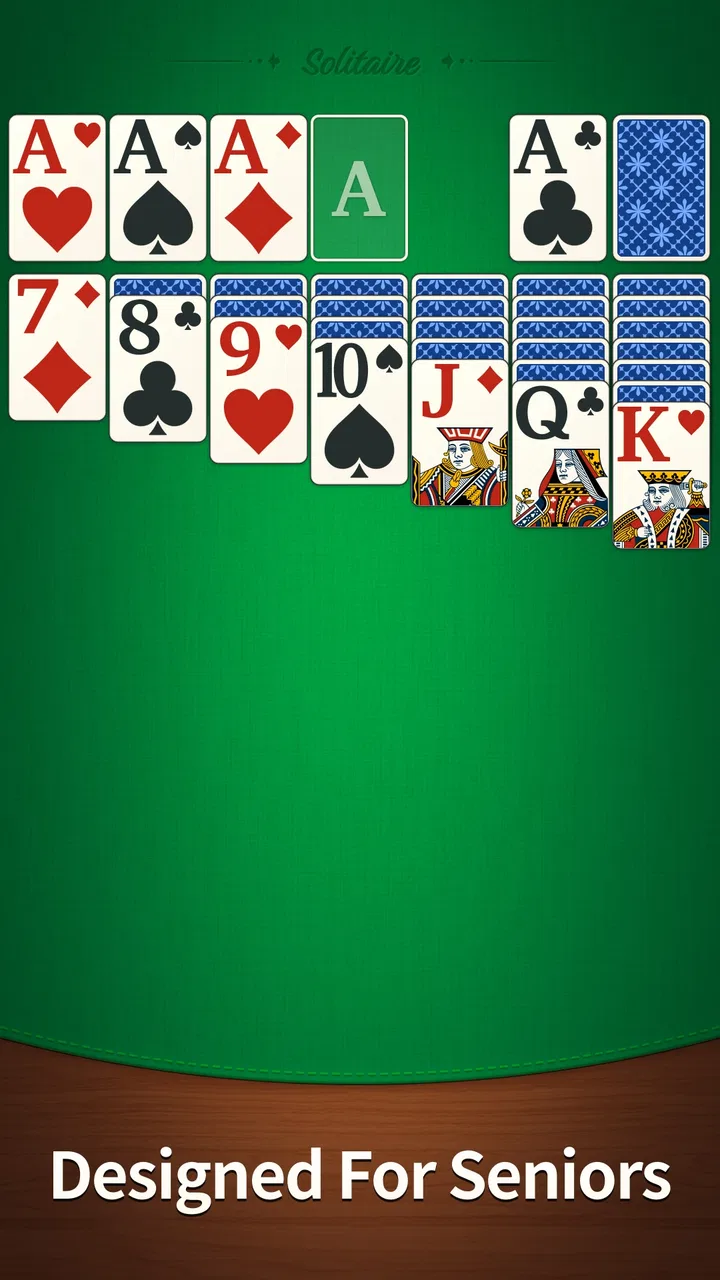
The game’s store summary describes it as a relaxing take on classic Solitaire, and that is a fair way to approach it. I found the basic experience most enjoyable when I treated each round as a small mental reset. The rules are familiar enough that I could begin without learning a new system, while the act of sorting cards still gives the mind something modest to focus on. That balance is the central strength here. It turns a short break into a quiet puzzle without asking for much attention or commitment.
How the classic card experience feels in everyday use
Calm Solitaire: Classic Card belongs to the card-game category, and its identity comes from keeping the traditional Solitaire format at the center. That matters because the usual appeal of Solitaire is not surprise; it is the dependable loop of revealing cards, building sequences, and deciding which move keeps the board open. I can pick it up while waiting for an appointment, during a short commute when I am not driving, or at the end of the day when I want an activity that is more engaging than scrolling but less intense than a competitive game.
You May Also Like

 Blood Strike: 2.5 Anniversary
Blood Strike’s Loadouts Turn Every Drop Into a Tactical Gamble
A close look at Blood Strike’s custom loadouts: how fast access to signature weapons reshapes its battle royale rhythm, rewards preparation, and narrows the gap between fights.

 Pandora - Music & Podcasts
Pandora’s Music Is Easy to Start, but Harder to Recover
Pandora’s strength is its low-effort path from a seed to a station. Its weak spot is how much confidence it asks you to place in connection, setup, and quiet recovery.

 8 Ball Pool
 Is Built on Rivalries, Rematches, and Routine
A close look at the rivalries, rematches, shared routines, and unanswered safety questions that turn a quick pool match into a persistent mobile community.

 Samsung Music
’s Quiet Strength Is Playing What You Already Own
Its reach comes less from spectacle than from dependable access to a personal library. That simplicity is both the app’s strongest retention engine and its ceiling.

 AccuWeather: Weather Radar
AccuWeather Review: A Quick, Clear Forecast for Everyday Decisions
For everyday plans, the best forecast is the one you can understand quickly. AccuWeather makes rain timing, radar, and local conditions easy to act on, with a few trade-offs.

 Hill Climb Racing
Why Hill Climb Racing Still Turns Crashes Into One More Run
A tiny car, a bumpy hill and one more upgrade: Hill Climb Racing keeps resurfacing because its simple chaos makes every near-miss feel personal.
More From Our News Desk
View All News


The best sessions are the unplanned ones. I might open it expecting to play briefly, complete a round, and then decide whether I have the patience for another. That makes it a useful companion for small gaps in the day. Unlike a fast action game, it does not require quick reactions. Unlike a multiplayer card game, it does not put me under pressure to respond to another person. The pace comes from my own decisions, which gives the experience a naturally calm character.
That calmness also changes how I judge mistakes. In a more aggressive puzzle game, a poor move can feel like a failure that demands an immediate restart. Here, a mistake is usually just a reason to reconsider the board. I found myself looking further ahead instead of tapping quickly. A practical habit is to pause before moving a card from a visible stack: first check whether that move uncovers something useful, then consider whether it blocks a better sequence. This small discipline makes the classic format feel more thoughtful without making it complicated.
Another useful approach is to avoid treating every available move as equally valuable. Moving a card simply because it can be moved may create a prettier arrangement while reducing future options. I had better results when I prioritized moves that revealed hidden cards or opened an empty space, especially when that space could receive a longer sequence. This is not an advanced feature in the app; it is a way to get more satisfaction from the familiar rules. The game rewards patience more than speed.
For new players, the traditional structure is approachable because the objective is easy to recognize. For experienced Solitaire players, the attraction is more about convenience and presentation than discovery. You already know the basic ideas, so the question becomes whether this particular version feels comfortable enough to keep installed. In my experience, its straightforward focus helps it avoid the clutter that can make some casual card games feel more like storefronts than games.
Why its simplicity is a genuine strength
Many mobile card games try to add daily challenges, missions, competitive rankings, collections, or several variations at once. Those additions can be enjoyable, but they also change the reason people open the game. Calm Solitaire: Classic Card is more appealing when I want the card layout itself to be the main event. There is less mental overhead in deciding what to do next outside the round, and that supports the relaxing purpose.
This makes it especially suitable for people who have never developed a taste for elaborate mobile games. Someone who understands ordinary Solitaire can start with little friction, while someone returning to the format after years away can use it as a gentle refresher. I would also recommend it to players who want a quiet offline-style pastime in spirit, even though I would not assume anything about connectivity or other technical behavior beyond what is stated for the game.
The game is free, which lowers the barrier to trying it. That does not automatically make every free game good, but here the simple format means I do not need to invest much time before deciding whether it suits me. The audience rating is Everyone, so its basic presentation is positioned for a broad audience rather than a mature or specialized one. Families looking for a straightforward card activity may find that approachable, although younger players who need constant variety may lose interest sooner than adults who enjoy repetition.
Its current version is 1.6.265, and it supports devices running Android 7.0 or later. Those details are useful when deciding whether an older phone or tablet is a realistic candidate. I would still check the device’s available storage and general responsiveness before expecting a perfectly smooth experience, because an operating-system requirement alone does not describe every handset’s performance. The practical point is that the game is not aimed only at the newest devices.
The small decisions that make rounds more satisfying
One of the most useful ways I found to play is to separate a “safe” move from a “productive” move. A safe move preserves the current arrangement, while a productive move exposes information or creates room for a more flexible sequence. When the board offers both, I usually choose the productive option, but only after checking whether it will trap a card that I need later. This gives each turn a little more meaning than simply clearing whatever is immediately available.
I also recommend using short sessions as a deliberate limit. Solitaire can become repetitive when I continue after my attention has faded, and tired decisions are rarely interesting. Playing one or two rounds during a break keeps the game in its strongest setting. It is less effective as a substitute for a large evening game because the core loop is intentionally narrow. The same simplicity that makes it relaxing can make it feel thin if I expect constant novelty.
A third tip is to use the game as a focus transition rather than as background noise. If I open it while switching between messages, videos, and other distractions, the card decisions become less satisfying. When I give a round even a few uninterrupted minutes, I notice the pattern-recognition side more clearly. That is where this particular game earns its place: not through spectacle, but through a small, contained task.
Where the experience may fall short
The main limitation is also the most obvious consequence of its classic design: there is only so much variety a traditional Solitaire loop can provide. Players who expect a broad card collection, unusual rules, story chapters, or a substantial reward structure may find the experience too restrained. I would not choose it for a group of friends seeking interaction, and I would not recommend it to someone who needs a steady stream of new objectives to stay interested.
There is also a difference between “calm” and “deep.” The game can encourage careful planning, but that does not mean it offers the strategic range of a more complex card title. If I want bluffing, direct competition, deck construction, or meaningful character progression, I would look elsewhere. This is a solitary puzzle first. Its value comes from accessibility and mood, not from a large strategic system.
Another trade-off is that familiar rules can reduce the sense of achievement for experienced players. Once the basic patterns become automatic, some rounds may feel more like routine than discovery. That is not a defect for everyone; routine is exactly what some people want from a relaxing game. Still, it is worth being honest about the target. The app is strongest for short, repeatable play, and weaker for players who measure value by constant expansion.
The public response suggests that the game has found a reasonably positive audience, with an average rating of 4.6 from around 326 ratings and roughly 23 written reviews. It has also passed 100K installs, which indicates that it is not an obscure experiment with no player interest. I would treat those figures as useful signs of reception rather than proof that every player will enjoy it. Solitaire preferences are personal: interface habits, pacing, card visibility, and tolerance for repetition can matter more than a general score.
Who should install it, and who should pass
I think Calm Solitaire: Classic Card is a good fit for adults who want an uncomplicated way to occupy short breaks, people returning to classic card games, and players who prefer solitary activities without time pressure. It also suits anyone who likes a game that can be understood immediately and revisited without remembering a plot or maintaining a complicated build. Because it is free and rated for Everyone, trying it does not require a significant commitment.
A realistic use case is a quiet evening when I have finished the tasks that require concentration but am not ready to sleep. A round gives me a clear endpoint and enough structure to keep my mind from wandering, without the emotional intensity of a competitive match. Another is a waiting room: I can begin a game, stop when my turn arrives, and return later without needing to coordinate with another player. Those situations show why the restrained design is practical rather than merely basic.
I would be more cautious about recommending it to someone who wants a social card experience. If your favorite part of card games is reading an opponent, building a specialized deck, or playing through a changing campaign, this will probably feel limited. Likewise, players who dislike repeated layouts or who need frequent unlocks may enjoy it briefly and then move on. A more feature-heavy Solitaire alternative would be better for those users, while a competitive card game would make more sense for anyone seeking interaction.
It is also not the first choice for children who need a highly varied game to hold their attention. The Everyone rating means the content is broadly accessible, but age suitability and entertainment value are different questions. A child who already enjoys sorting cards and thinking through sequences may appreciate it; a child looking for colorful action or constant rewards may not. I would judge that choice by the player’s temperament rather than by the age label alone.
How it compares with common alternatives
Compared with a physical deck of cards, the app is more convenient because it is always available on a compatible device and does not require a table. A physical deck offers a tactile quality that a screen cannot reproduce, and it can be better when I want to play with another person. The digital version wins when I am alone, short on space, or looking for a quick round without setup and cleanup.
Compared with a feature-packed Solitaire app, this one is attractive precisely because it does not make the surrounding experience the main challenge. A larger alternative may offer more modes and longer-term goals, but it may also demand more menus, more decisions, and more attention than I want during a break. I would choose Calm Solitaire: Classic Card when simplicity is the priority, and a broader app when I know I want variety.
Compared with a competitive online card game, the difference is even clearer. This game lets me control the pace and avoids the pressure of another player’s turn. The trade-off is that it cannot provide the excitement of an unpredictable opponent or the satisfaction of winning a tightly contested match. Neither approach is universally better; they serve different moods. This one is for quiet concentration, not social tension.
My final view after using it
Puzzle Brain Games has made a sensible choice by keeping this release focused on the familiar Solitaire format. I like it most when I need a small, self-contained activity that does not ask me to learn systems, follow a story, or compete. The free price, broad age rating, and support for Android 7.0 or later make it easy to consider, while the positive reception and growing install base suggest that its uncomplicated approach resonates with many players.
My recommendation is specific: install it if you want classic card play for short, peaceful sessions and are comfortable with repetition. Do not install it expecting a large library of modes, social competition, or a deep progression system. The right expectation is the key to enjoying it. As a focused Solitaire game, it is pleasant, accessible, and useful in everyday downtime. As an all-purpose card-game replacement, it is too narrow.
For me, that narrowness is acceptable because the app knows what it wants to be. I can open it, make a few careful decisions, and leave without feeling that I have started another demanding obligation. That is a modest achievement, but for a casual card game, it is the one that matters most. If your ideal mobile game is a calm mental pause rather than a long-term hobby, Calm Solitaire: Classic Card is worth trying.
FAQs for Calm Solitaire: Classic Card
01What is Calm Solitaire: Classic Card?
Calm Solitaire: Classic Card is a digital version of the classic card game Solitaire, designed for both Android and iOS. It offers a serene and visually appealing gaming experience, ideal for relaxing and unwinding. The app includes various game modes and customizable themes to enhance user enjoyment.
02Is Calm Solitaire: Classic Card free to play?
Calm Solitaire: Classic Card is free to download and play with optional in-app purchases. These purchases can enhance gameplay by offering additional themes, card designs, or ad-free experiences. While the core game remains free, spending is entirely optional and not necessary for enjoying the game.
03Does Calm Solitaire: Classic Card require an internet connection?
No, Calm Solitaire: Classic Card can be played offline, making it perfect for users who want to enjoy a game without an internet connection. However, an internet connection may be needed for initial downloads, updates, or accessing certain features such as in-app purchases or leaderboards.
04What features make Calm Solitaire: Classic Card unique?
Calm Solitaire: Classic Card stands out with its soothing graphics and soundscapes designed to enhance relaxation. It also offers various customizable themes and card designs, daily challenges, and leaderboards to keep the gameplay fresh and engaging. Its user-friendly interface ensures accessibility for players of all ages.
05Are there any ads in Calm Solitaire: Classic Card?
Yes, Calm Solitaire: Classic Card includes ads, which help keep the game free. However, users have the option to purchase an ad-free version through in-app purchases. This allows for uninterrupted gameplay, enhancing the overall user experience, especially for those who find ads disruptive.
Pros
- Intuitive and easy-to-use interface.
- Classic gameplay with modern graphics.
- Daily challenges for extra rewards.
- Offline mode available for travel.
- Minimal ads for uninterrupted play.
Cons
- Limited customization options.
- No multiplayer or social features.
- In-app purchases for extra features.
- Occasional minor bugs in updates.
- Lacks variety in card back designs.

Calm Solitaire: Classic Card
Gallery